Congress Scores 0%: The Scorecard That Exposes What 540 Representatives Are Ignoring
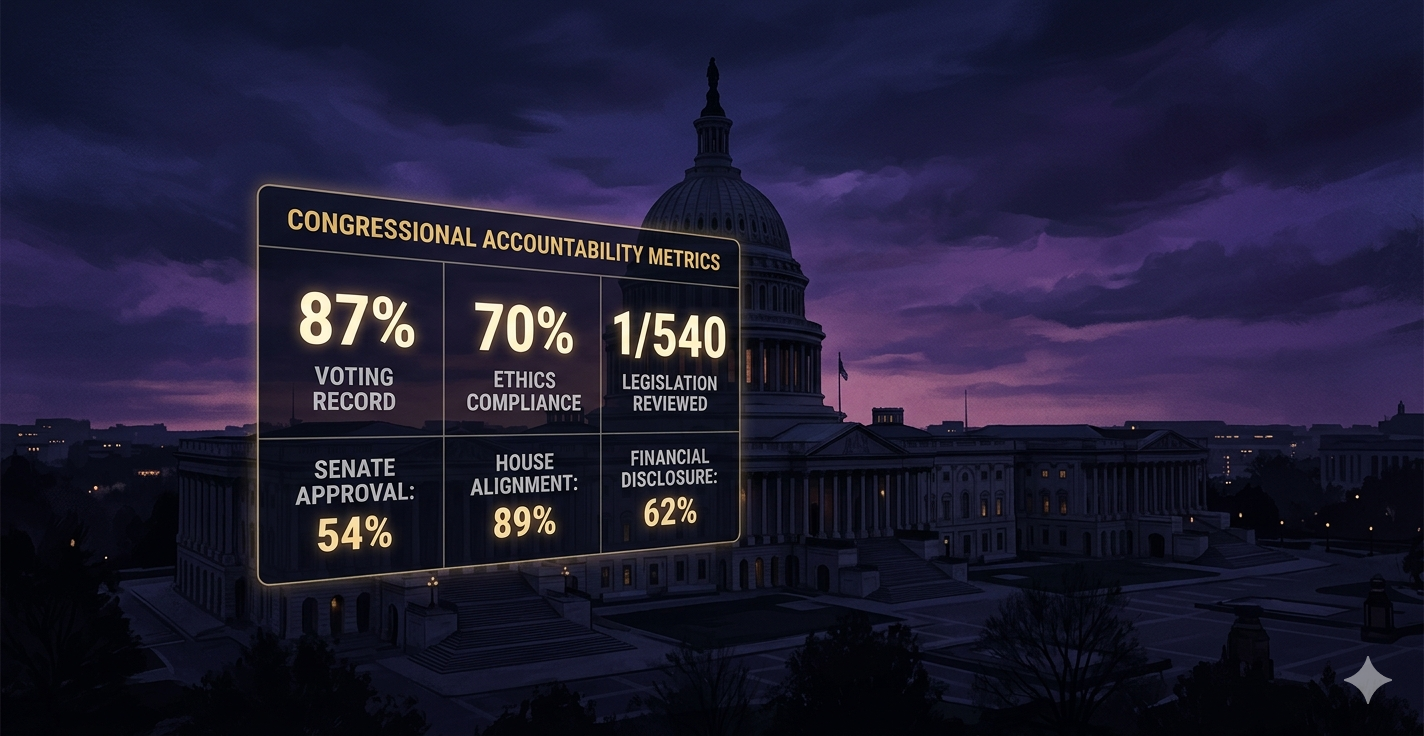
Congress Scores 0%: The Scorecard That Exposes What 540 Representatives Are Ignoring
What if I told you there are 10 policy issues that 70% or more of Americans already agree on, backed by years of credible polling data, and Congress is doing essentially nothing about any of them?
That is not hyperbole. That is the finding of Seven Ten (seventen.org), a nonpartisan, nonprofit, pro-democracy organization that I recently had the privilege of discussing on the Purple Political Breakdown podcast with Seven Ten's director, Joe Patterson.
The Problem Is Not Disagreement. It Is Inaction.
We have been conditioned to believe that Washington is broken because Americans are too divided. The data tells a different story. On issues like congressional term limits, Medicare drug price negotiation, universal background checks, a path for dreamers, and opposition to Citizens United, supermajorities of Americans (70% to 90%) already agree. These are not fringe positions. These are consensus positions that cross party lines, demographic groups, and geographic regions.
Congressional term limits alone poll at 87% to 90% support and have maintained that level for decades. That is not a trend. That is a permanent feature of American public opinion. Both Republican and Democratic voters want it. Yet Congress has not held a vote on term limits since 1995.
The Scorecard: A Mirror for Congress
Seven Ten created a straightforward scoring system. Ten issues. Each worth 10 points. Score 100% and you are fully aligned with the American supermajority. Score 0% and you are completely disconnected from what the vast majority of your constituents want.
Out of 540 representatives scored, only one cleared the bar.
Let that sit for a moment. Fewer than 0.2% of our representatives are aligned with the issues that 70% or more of Americans support.
Joe Patterson pointed out something that should concern every voter regardless of party: bills pass at the same rate in Congress whether they have 30% public support or 70% public support. The will of the people is statistically irrelevant to legislative outcomes. Representatives are responding to party leadership, lobbyist agendas, and fundraising incentives. Not to you.
What Makes Seven Ten Different
Having spent years covering political organizations and reform movements on the Purple Political Breakdown podcast, I can tell you that Seven Ten does several things I have rarely seen elsewhere.
First, their methodology is transparent and data-driven. They draw from established polling sources, require consistent supermajority support over multiple years (not just a single poll cycle), and update their issue list on a two-year cycle aligned with House terms. If the data changes, the issues change. They are not married to topics. They are married to consensus.
Second, they have model legislation ready for their top three issues: congressional term limits (12 years per chamber with crossover allowances), Medicare drug price negotiation, and universal background checks. These are written as clean bills, meaning no pork, no earmarks, no omnibus packaging. The idea is to remove every excuse a representative might use to vote no.
Third, their financial transparency is remarkable. Seven Ten maintains a live ledger on their website showing every single transaction in real time. Every donation. Every expense. The running balance. Joe told me he would not have started the organization if they could not build an API hook directly into their bank account for public visibility. That level of accountability is almost unheard of in the nonprofit space.
Fourth, they have a candidate pledge system with real teeth. Candidates who sign the pledge commit to supporting all 10 issues. The contract explicitly states that if they break any commitment, Seven Ten will publicly call them a liar. No euphemisms. No political courtesy. Just accountability.
The Bipartisan Failure
One of the most revealing findings from Seven Ten's scorecards is that neither party fully represents the American consensus. Democrats score higher on average across the 10 issues overall. But on congressional term limits, the single highest-polling issue in the country, Republicans significantly outperform Democrats. About 30% of Republican representatives support term limits versus under 5% of Democrats.
This means that no matter which party you support, your representatives are failing you on the issues that matter most to the broadest coalition of Americans. The question is whether voters will start using tools like the Seven Ten scorecard to hold their representatives accountable in primaries and general elections.
The 2026 Midterm Opportunity
With 2026 midterms approaching, dissatisfaction with both parties is running high. Voter engagement is intensifying. The conditions are ripe for a tool like Seven Ten to gain real traction.
Joe's analogy captures it perfectly: if the group is lost in the woods and half want east and half want west, but everyone agrees on south, just go south. Get out of the woods first. Then argue about directions.
The 10 issues on Seven Ten's list are the "south." They are not sexy. They are not inflammatory. They are just the things we already agree on that nobody in Congress is doing anything about.
Maybe it is time we started asking our representatives a very simple question: if 87% of Americans want congressional term limits, why have you not voted for them?
Listen to the full conversation with Joe Patterson on the Purple Political Breakdown podcast: http://podcasts.apple.com/us/podcast/the-10-issues-70-of-americans-agree-on-that/id1626987640?i=1000755756347
Learn more about Seven Ten, view the scorecards, and explore their methodology at seventen.org.
Sources:
Pew Research Center, 2023 survey data: 87% of Americans support limiting congressional terms.
Gallup, "Americans Call for Term Limits, End to Electoral College": 74% historical support for term limits amendment across party lines.
Program for Public Consultation, University of Maryland, "Five-in-Six Americans Favor Constitutional Amendment on Term Limits": 83% of registered voters nationally favor term limits (86% Republicans, 80% Democrats, 84% independents).
U.S. Term Limits (termlimits.com): Kansas became the 16th state to call for an Article V convention for congressional term limits in February 2026.
Seven Ten (seventen.org): Organizational scorecards, methodology, model legislation, and live financial ledger.

Podcast Host
Navigating the vast amount of bouncing around the political spectrum my entire life I have finally figured something important out. It doesn't matter. I've been religious, been in the military, went to a liberal school and all in all none of the political biases matter. We shouldn't let toxic discourse cloud our judgement and find a solution through logic and conversation. In pursuit of this mission I created this podcast to focus on these important conversations.

The Iran War, AI's Moral Reckoning, and Why the Pardon System Is Broken: Connecting the Dots on America's Worst Week