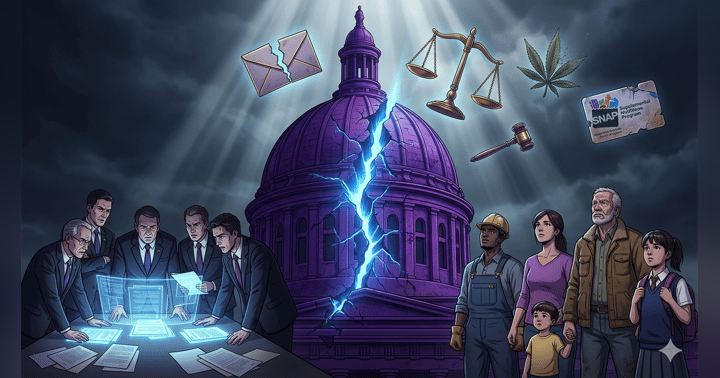
Can Democrats Pack the Supreme Court? The History, the Proposals, and What It Would Actually Take
The phrase "court packing" has become one of the most debated terms in American politics. It gets thrown around in cable news segments and social media arguments, but most people do not actually understand what it means, whether it is legal, or how close it has come to happening before. On this week's Purple Political Breakdown, I broke down the history, the current proposals, and the real arguments on both sides. Here is what everyone should know.
The Constitution Does Not Say Nine
This is the foundational fact that surprises most people. Article III of the Constitution establishes one Supreme Court but says absolutely nothing about how many justices should sit on it. The number is set by Congress through the Necessary and Proper Clause, not by any explicit constitutional grant. That means changing the number of justices requires only a regular bill passed by Congress and signed by the president. No constitutional amendment is needed.
The Court Has Changed Size Seven Times
The court started at 6 justices in 1789, dropped to 5 in 1801, returned to 6 in 1802, expanded to 7 in 1807, grew to 9 in 1837, jumped to 10 during the Civil War in 1863, was reduced to 7 in 1866 specifically to prevent Andrew Johnson from making appointments, and was restored to 9 in 1869 where it has remained. According to the Congressional Research Service, the framers designed the judiciary to be independent from political branches. Alexander Hamilton argued in the Federalist Papers that judicial independence was essential to guard constitutional rights. Article III's life tenure provision was specifically designed to insulate judges from political pressure, which is why reform efforts run into tension with separation of powers principles.
What Court Packing Actually Means
Court packing means adding new seats to the Supreme Court so the sitting president can fill them with ideologically aligned justices. It is the fastest path to changing the court's direction because it requires only a simple bill through Congress. The Judiciary Act of 2021 proposed expanding from 9 to 13 justices, which would have given President Biden 4 appointments.
The most famous attempt was FDR's 1937 plan. After the court struck down parts of the New Deal, Roosevelt proposed adding one justice for every sitting justice over age 70, potentially expanding the court to 15. He framed it as an efficiency issue, but voters and members of both parties saw it as a power grab. The plan failed in Congress, but the court began ruling more favorably on New Deal legislation anyway, a shift historians call "the switch in time that saved nine."
The Escalation Argument
The biggest argument against court packing is the escalation trap. Once one side expands the bench, the other side has every incentive to do the same when it gains power. You could end up with a 17, then 27, then 49 member court that functions less like a judicial body and more like a secondary legislature. Justice Ruth Bader Ginsburg warned against expansion, saying "nine seems to be a good number" and cautioning that changing the size invites retaliation.
Opponents like the Factual America article compare court packing to what happened in Venezuela and Hungary, where ruling parties restructured courts to rubber stamp their policies. While the U.S. is not those countries, the structural dynamics of packing courts are universal: they undermine judicial independence.
The Case for Term Limits
If there is one reform with genuine bipartisan public support, it is term limits. An AP NORC poll found 67% of Americans support term limits or a mandatory retirement age for Supreme Court justices. The most popular proposal is 18 year terms where each president would appoint one justice every two years. Once fully phased in, this would make appointments predictable and reduce the randomness that let President Carter appoint zero justices while Trump appointed three in a single term.
The Supreme Court Term Limits and Regular Appointments Act of 2025 was introduced in February 2025 by Representatives Ro Khanna and Beyer. Under this bill, after 18 years a justice would be deemed retired from regular active service. Current justices would be grandfathered in, meaning the transition would take decades.
The legal challenge is Article III's "good behavior" clause, which has been interpreted to guarantee lifetime appointment. Many scholars argue that imposing term limits by statute could face court challenges because of that clause, meaning a constitutional amendment may be required to make term limits bulletproof. The U.S. is the only major constitutional democracy in the world with neither a retirement age nor fixed term limits for its highest court justices.
The Ethics Code Gap
The Supreme Court is the only court in the federal system not bound by an enforceable code of ethics. Lower federal judges follow the Code of Conduct for United States Judges, but justices police themselves. The push for reform intensified after ProPublica's reporting on Justice Clarence Thomas' undisclosed trips funded by GOP mega donor Harlan Crow and questions about Justice Alito's conduct.
President Biden proposed requiring justices to disclose gifts, recuse themselves from cases involving financial or other conflicts of interest, and submit to external enforcement. Justice Kagan has acknowledged she believes there should be a binding code, though she noted enforcement mechanisms would be difficult given the question of who polices the highest court. This is the most legally straightforward reform because it requires only congressional legislation, not a constitutional amendment.
Where We Stand
The current Supreme Court has a 6 to 3 conservative majority, and recent rulings have raised serious questions about judicial independence. Whether the solution is expanding the court, implementing term limits, enforcing ethics codes, or some combination of all three remains one of the defining governance questions of this era.
What is clear is that the system the framers designed has not produced the outcome they intended. Justices were supposed to be insulated from political pressure. That insulation has not held. The question is no longer whether reform is needed. The question is what form it should take and whether the political will exists to pursue it.
This topic was covered in depth on this week's Purple Political Breakdown. Full episode here: https://podcasts.apple.com/us/podcast/can-democrats-pack-the-supreme-court-plus-the-iran/id1626987640?i=1000758694105
I would love to hear your thoughts. Where do you land on Supreme Court reform? Is court packing too dangerous, or is it necessary given the current environment? Are term limits the safer path? Drop your perspective in the comments.
Radell Lewis is the host of the Purple Political Breakdown on the Alive Podcast Network. Political solutions without political bias.

Podcast Host
Navigating the vast amount of bouncing around the political spectrum my entire life I have finally figured something important out. It doesn't matter. I've been religious, been in the military, went to a liberal school and all in all none of the political biases matter. We shouldn't let toxic discourse cloud our judgement and find a solution through logic and conversation. In pursuit of this mission I created this podcast to focus on these important conversations.
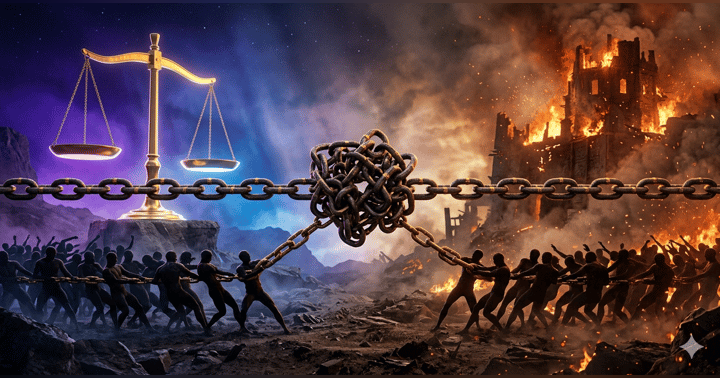
The Retaliation Chain: Why How Democrats Use Power Matters More Than Whether They Get It