Could 21 Million Americans Lose Their Right to Vote? Inside the Multi-Front Battle Over the 2026 Elections
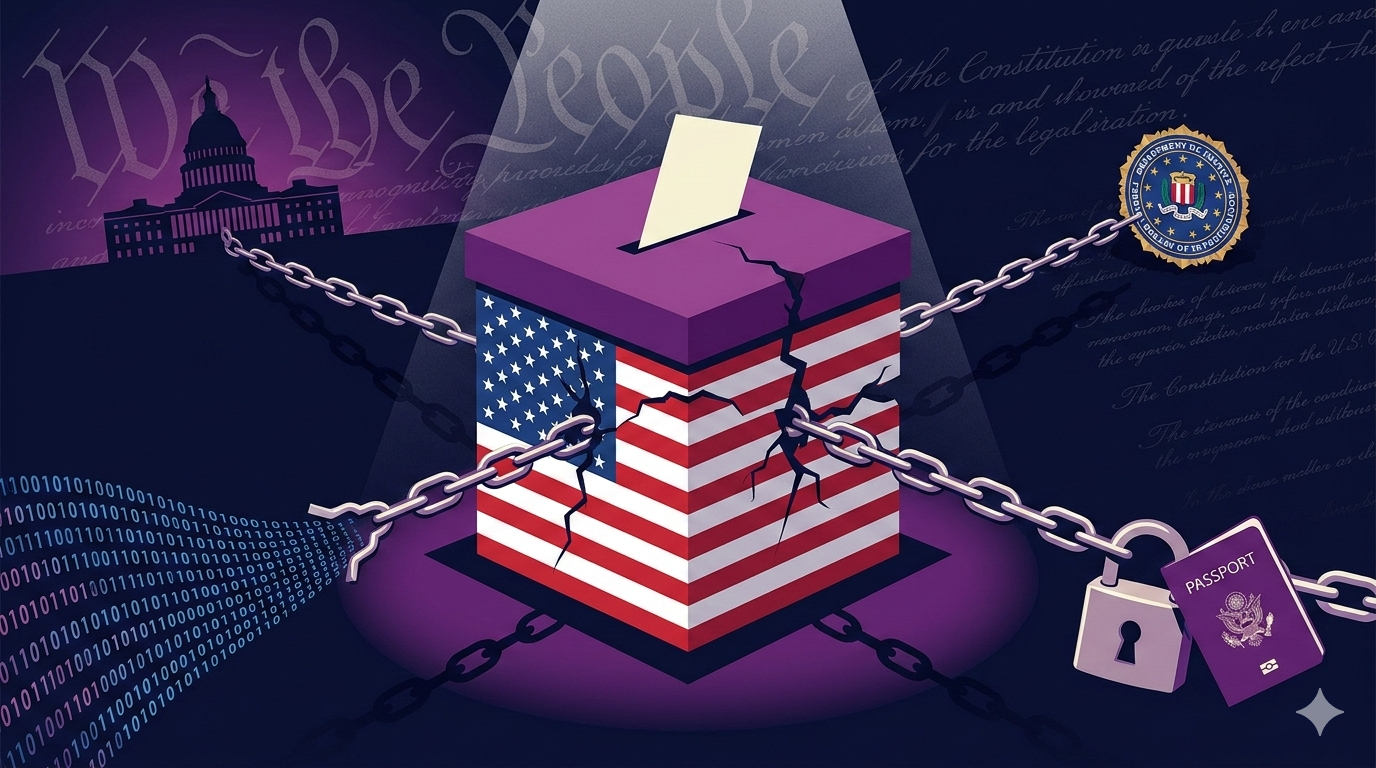
There are moments in American civic life when policy proposals stop being theoretical and start becoming structural. We are in one of those moments right now.
As someone who has spent years analyzing election policy, voter access, and civic engagement (as a Ballotpedia Fellow, an outreach coordinator for voting reform organizations, and now as the host and producer of Purple Political Breakdown) I want to lay out what is actually happening to American elections in 2026, because I believe every professional, every business leader, and every civic-minded American needs to understand it.
This is not a partisan argument. This is a factual accounting of what is moving through Congress, what is happening in federal agencies, and what the data says.
The Legislation: The SAVE America Act
The SAVE America Act passed the House of Representatives 218-213 in February 2026. At its core, the bill would require every American to produce documentary proof of citizenship (a passport, birth certificate, or naturalization certificate to register to vote in federal elections. It would also impose a strict photo ID requirement at the polls, mandate states share their voter rolls with the Department of Homeland Security, require voter roll purges every 30 days, and prohibit universal mail voting.
The workforce implications alone are staggering. According to the Brennan Center for Justice, more than 21.3 million voting-age Americans lack ready access to the required citizenship documents. Roughly 51% of Americans do not have a passport. An estimated 69 million women who changed their names after marriage would need to produce additional documentation like a certified marriage license every time they update their registration. For professionals who have moved for work, changed their names, or simply never obtained a passport, registering to vote under this bill would require time off work, document retrieval fees, and in-person visits to election offices that could be hundreds of miles away.
When Kansas enacted a nearly identical law, it blocked more than 31,000 eligible citizens from voting before a federal court struck it down as unconstitutional in 2018.
The Data: What Noncitizen Voting Actually Looks Like
The stated justification for the SAVE Act is preventing noncitizen voting. Here is what the data shows: Michigan audited 7.2 million registered voters from the 2024 election and found 15 suspected noncitizens who voted 0.000028%. Utah reviewed 2.1 million voters and found one confirmed noncitizen on the rolls, who had never voted. Georgia found 20 registered noncitizens out of 8.2 million, with only 9 having ever cast a ballot. Noncitizen voting is already a federal crime punishable by jail time, fines, and deportation.
From a risk-assessment perspective, the SAVE Act proposes disenfranchising millions of eligible citizens to address an issue affecting a statistically negligible number of people.
The Data Breach: DOGE, the SSA, and the Voter Data Agreement
In a January 2026 court filing, the Department of Justice admitted that DOGE staffers embedded at the Social Security Administration signed a “Voter Data Agreement” with a political advocacy group seeking to cross-reference voter rolls with federal databases, four days after a judge had issued a restraining order blocking that access. The agreement was never approved through SSA’s data exchange procedures. No SSA employees outside the DOGE team knew about it. SSA only discovered it during an unrelated review months later. Two employees have been referred for Hatch Act violations.
For anyone working in data governance, compliance, or information security, this should set off every alarm. Unvetted political operatives accessed one of the largest repositories of personal data in the federal government Social Security numbers, bank account information, health records, wage histories, immigration status and cut a deal with an outside group, using an unapproved server, with zero oversight.
The Enforcement Action: The Fulton County FBI Raid
On January 28, 2026, FBI agents executed a search warrant at the Fulton County, Georgia Elections Hub, seizing approximately 656 boxes of 2020 election documents including original ballots and voting machine tabulators. The warrant cited statutes with a five-year statute of limitations. The affidavit relied on debunked claims sourced from known election conspiracy theorists. Director of National Intelligence Tulsi Gabbard was present despite having no domestic law enforcement authority a statutory limitation that exists because intelligence agencies possess surveillance powers the Fourth Amendment prohibits from domestic use.
As election law expert Rick Hasen noted on PBS, the real concern is not what this means for 2020 it is the signal it sends to every election administrator in every competitive county heading into 2026.
The Infrastructure Collapse: ERIC and CISA
Nine states left ERIC, the bipartisan voter roll maintenance system, after false conspiracy theories spread by Gateway Pundit alleged it was a Soros-funded partisan operation. Officials in Iowa and Ohio publicly praised ERIC before leading their states’ withdrawals. These states now have less accurate voter rolls and are spending more money on inferior alternatives. Meanwhile, CISA the federal agency created in 2018 specifically to protect election systems from foreign cyber attacks has had its staff fired, its election security activities frozen, and its Election Day situation room shut down for the first time in years.
Why This Matters for Every Professional
Elections are not abstract. They determine the regulatory environment your business operates in, the tax code your organization plans around, the labor laws your HR teams implement, and the infrastructure investments your communities depend on. When the systems that ensure those elections are free and fair come under coordinated pressure from legislation, executive action, data breaches, and law enforcement operations simultaneously that is not a partisan issue. That is a structural risk.
I covered all of this in depth on the latest episode of Purple Political Breakdown. I come at this with one commitment: facts over faction, accountability across the political spectrum, and solutions over outrage.
Listen to the full episode: https://podcasts.apple.com/us/podcast/the-election-takeover-how-the-save-act-doge-and/id1626987640?i=1000754000595
Sources:
Brennan Center for Justice “New SAVE Act Bills Would Still Block Millions of Americans From Voting” (February 2026)
Campaign Legal Center “What You Need to Know About the SAVE Act” (February 2026)
Center for American Progress “The SAVE America Act Explained” (March 2026)
Democracy Docket “DOGE Worked With Political Group to Probe Voter Rolls” (January 2026)
Democracy Docket “FBI’s Fulton County Raid May Have Been Illegal” (January 2026)
NPR “The Trump Administration Admits Even More Ways DOGE Accessed Sensitive Personal Data” (January 2026)
CNN “DOGE Shared Social Security Data to Unauthorized Server” (January 2026)
Washington Post “Trump Administration Admits DOGE Accessed Personal Social Security Data” (January 2026)
Georgia Recorder “FBI Raid in Fulton County Relied on Previously Investigated 2020 Election Claims” (February 2026)
PBS NewsHour “FBI Raid of Election Offices Ignites Debate Over Voting Security and Federal Authority” (January 2026)
Democracy Forward: FOIA requests and court filings re: DOGE-SSA misconduct (January 2026)
ACLU “ACLU Condemns House Passage of SAVE America Act” (February 2026)
Congress.gov: H.R. 22 and CRS Report IF12902 on SAVE America Act (2026)
Votebeat “How the SAVE America Act Would Affect the 2026 Elections” (February 2026)
University of Maryland Center for Democracy and Civic Engagement: 2023 citizenship documentation survey

Podcast Host
Navigating the vast amount of bouncing around the political spectrum my entire life I have finally figured something important out. It doesn't matter. I've been religious, been in the military, went to a liberal school and all in all none of the political biases matter. We shouldn't let toxic discourse cloud our judgement and find a solution through logic and conversation. In pursuit of this mission I created this podcast to focus on these important conversations.

War, Firings, Job Losses, and an AI Showdown: The Week That Exposed Every Fault Line in America