Executive Orders Are Not Laws: Why Trump's Record-Breaking Use of Presidential Directives Cannot Substitute for Governance
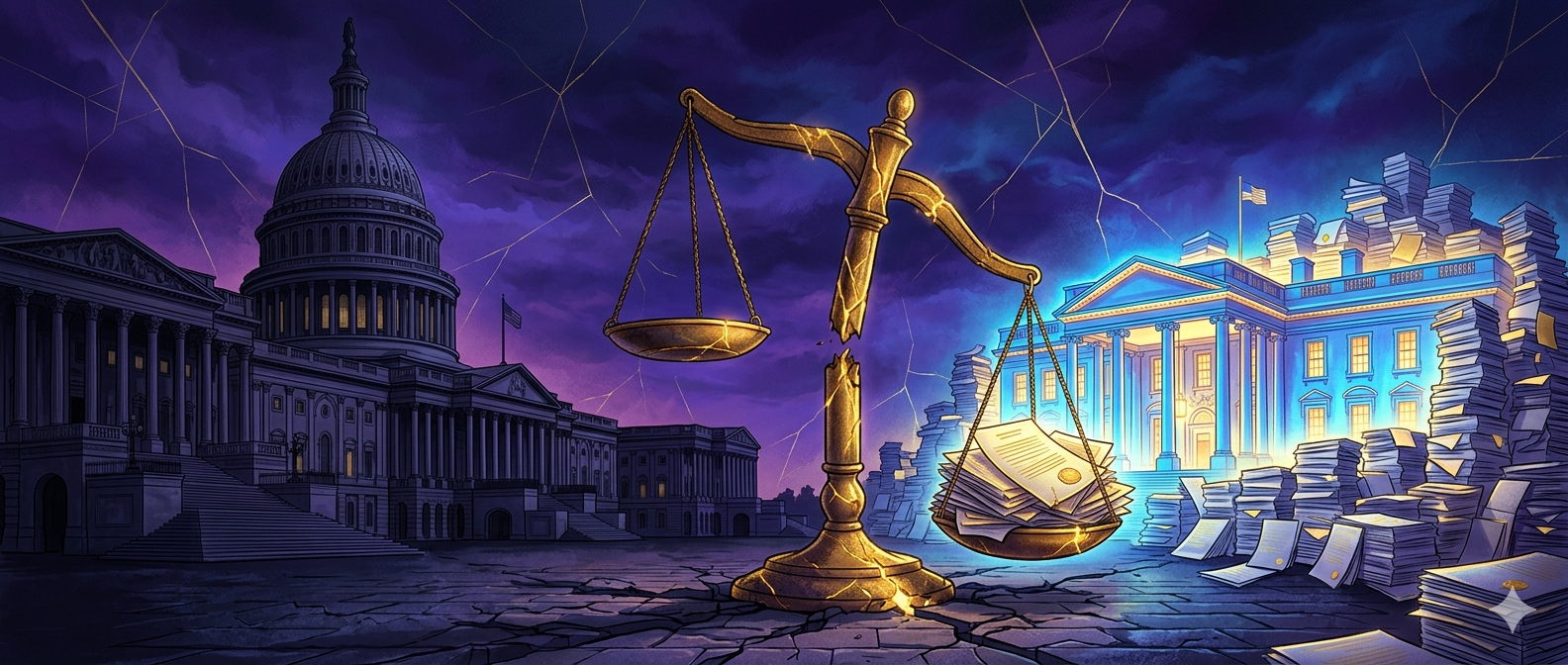
The United States is currently governed more by executive orders than by legislation. That is not hyperbole. It is a measurable fact. In his first 100 days back in office, President Trump signed 147 executive orders but only 5 bills into law. That is a record low for legislation and a record high for executive directives in the modern era. This imbalance raises fundamental questions about how the country is being run and whether the balance of power between the executive and legislative branches is functioning as designed.
On the latest episode of Purple Political Breakdown, I broke down what executive orders actually are, what they can and cannot do, and why relying on them as a primary governing tool creates fragile policy that can be undone with a single signature from the next president.
What Executive Orders Actually Are
An executive order is a written directive signed by the president that orders the federal government to take specific actions. The legal foundation comes from Article II of the Constitution, which vests the president with executive power and the obligation to ensure that laws are faithfully executed. Executive orders are numbered, published in the Federal Register, and the Office of Management and Budget is required to issue budgetary impact analysis for each one.
The critical limitation that most people do not understand is scope. Executive orders direct the executive branch only. They tell federal agencies how to implement existing law, establish policy priorities, and direct operations within the president's constitutional authority.
What Executive Orders Cannot Do
Executive orders cannot override federal statutes. They cannot create new taxes. They cannot appropriate money. They cannot declare war. They cannot take over powers belonging to Congress or the courts. These boundaries are not suggestions. They are constitutional requirements.
This is precisely why Trump's March 31st executive order creating a national voter database and restricting mail-in voting has been called unconstitutional by election law experts. States, not the president, control election administration. The executive branch has no authority over elections. Over two dozen states have already vowed legal challenges, and California has filed suit.
The Fragility Problem
Harvard Kennedy School professor Roger Porter, who served in the White House under three presidents, has noted that executive orders have recently eclipsed actual legislation as a governing tool. The problem with this approach is durability. Any future president can rescind or amend a previous president's executive orders with a stroke of the pen.
We have already seen this cycle play out. Obama signed orders on climate and immigration. Trump reversed them in his first term. Biden reversed Trump's reversals. Trump reversed Biden's reversals in his second term. This policy whiplash means executive orders represent temporary policy rather than durable governance. If the goal is to create lasting change for the country, executive orders are structurally incapable of achieving it.
Historical Context
Every president from George Washington to Donald Trump has issued executive orders. Franklin Roosevelt holds the all-time record with 3,721 across his four terms, including 568 in 1933 alone during the Great Depression. The trend generally declined over the twentieth century. Obama averaged about 35 per year. George W. Bush averaged about 36.
Trump has shattered the modern record. As of April 2nd, 2026, he has signed 254 executive orders, 59 memoranda, and 136 proclamations in his second term.
Executive orders have been used for some of the most consequential actions in American history. Lincoln's Emancipation Proclamation freed enslaved people in Confederate states. Truman's Executive Order 9981 desegregated the military. Johnson used an executive order to require federal contractors to comply with civil rights obligations. But executive orders have also been used for some of the worst government actions. Roosevelt's Executive Order 9066 forced the relocation and internment of over 120,000 Japanese Americans during World War II, later recognized as one of the greatest civil liberty violations in U.S. history.
The Current Situation
Multiple Trump executive orders have already been blocked by federal judges, including his election integrity order in March and his birthright citizenship order in January. Courts continue to draw lines around how far presidential authority extends. The ACLU has noted that even when an executive order is technically lawful, it can still cause real harm by reshaping how agencies operate day to day and signaling shifts in enforcement priorities.
The question facing the country is not whether executive orders are legal. Most of them are, within their proper scope. The question is whether a government run primarily through presidential directives, with Congress passing almost nothing, represents a healthy functioning democracy.
What Comes Next
If the goal is policy that endures beyond a single administration, the path runs through Congress. Legislation requires both chambers to vote, the president to sign, and survives changes in administration. Executive orders do not. The record disparity between executive orders and legislation in this administration is not a sign of strength. It is a sign that the legislative process has broken down.
We need to have a serious conversation about limiting executive order volume, restoring Congress as the primary lawmaking body, and ensuring that the presidency does not continue to accumulate powers that the Constitution assigned elsewhere.
Listen to the full breakdown on Purple Political Breakdown: https://podcasts.apple.com/us/podcast/iran-war-2026-gas-prices-surge-trump-executive-order/id1626987640?i=1000759377000
Purple Political Breakdown: Political Solutions Without Political Bias. Hosted by Radell Lewis on the Alive Podcast Network.

Podcast Host
Navigating the vast amount of bouncing around the political spectrum my entire life I have finally figured something important out. It doesn't matter. I've been religious, been in the military, went to a liberal school and all in all none of the political biases matter. We shouldn't let toxic discourse cloud our judgement and find a solution through logic and conversation. In pursuit of this mission I created this podcast to focus on these important conversations.

Ohio's Entire Executive Branch Is Turning Over in 2026. Here's What You Need to Know About the Secretary of State Race.