Four Crises Happening Right Now That Deserve Your Full Attention

War with Iran, AI in the military, social media's effect on kids, and the quiet erosion of voting rights
By Radell Lewis | Host & Producer, Purple Political Breakdown
We are living through one of the most politically dense periods in modern American history, and most people are only catching fragments of it. On the latest episode of Purple Political Breakdown, my panel and I broke down four major stories that are unfolding simultaneously. Each one deserves its own week of national conversation. Instead, they're competing for attention in a news cycle that moves faster than anyone can process.
Here's what you need to know.
The US-Iran Conflict Has Escalated Into a War
Regardless of how the administration frames it, the US is engaged in a military conflict with Iran. Eight Americans have died. 175 civilians were killed by a Tomahawk cruise missile strike. Oil tankers have been attacked in the Persian Gulf and near Oman. France deployed a frigate to help secure the Strait of Hormuz. The US destroyed Iranian mining vessels. Hezbollah and Israel exchanged over 100 missiles.
Senator Lindsey Graham publicly stated on Fox News that Iran "is not going to expect what is coming" in the next two weeks. Prime Minister Netanyahu echoed a similar timeline. Based on available reporting and analysis, the most likely next phase involves US-trained Kurdish forces entering western Iran to establish a foothold, potentially carving out a Kurdish territory. A MOAB strike is also on the table.
The broader implications are enormous. If the conflict continues to escalate and oil prices spike, we could be looking at both a geopolitical crisis and an economic recession simultaneously. The one potential upside: European leaders, including EU Commission President von der Leyen and French President Macron, are accelerating plans to build nuclear power plants and reduce dependence on oil from volatile regions. That shift, if it holds, would reshape global energy markets for decades.
AI Is Entering the Battlefield, and the Guardrails Are Coming Off
The Trump administration sought two things from AI companies: autonomous military drone capabilities and mass surveillance tools. Anthropic, the company behind Claude AI, refused on ethical grounds. The administration responded by labeling Anthropic a security risk and cutting them off from government contracts. Anthropic sued. OpenAI then stepped in to fill the void.
This is not a hypothetical future. AI-assisted warfare is already happening. Ukrainian forces use AI-powered drones to track Russian positions. Russia is developing parallel capabilities. The US military is almost certainly already incorporating AI into operations at some level.
The question is not whether AI will be used in warfare. It will. The question is whether we develop international standards for its use before it's too late. The comparison to nuclear weapons is instructive: we eventually reached global agreements on boundaries. AI needs the same framework. But the current US approach, executive orders to deregulate AI and the removal of safety provisions from major legislation, moves in the opposite direction.
For professionals in tech, defense, and policy, this is not an abstract debate. The decisions being made right now will define how AI is governed (or not governed) for a generation.
The Case for Banning Social Media for Minors Is Getting Stronger
France, Indonesia, Australia, and the United States are all moving toward restricting or banning social media for children under 16. The evidence supporting this is substantial.
Social media algorithms are engineered for maximum engagement, not user wellbeing. Children are spending 10 or more hours per day on platforms where they are exposed to misinformation, radicalization pipelines, unrealistic lifestyle content, and predatory behavior. Teachers across multiple countries have reported measurable behavioral changes in students linked to content from creators like Andrew Tate. The addiction metrics rival or exceed those of video game addiction from a decade ago.
The counterargument, that social media provides socialization opportunities and access to educational content, has merit. Creators like Mark Rober and Hank Green genuinely teach and inspire. But the data consistently shows that the net effect on minors is negative, particularly regarding mental health, social development, and susceptibility to misinformation.
The core problem: social media companies have no financial incentive to protect minors, and parental oversight has proven insufficient at scale. When both the market and the family unit fail to protect children, regulatory intervention becomes necessary.
For those of us in media, content creation, and tech, this is worth serious reflection. The platforms we use to build audiences and businesses are simultaneously damaging the youngest and most vulnerable users.
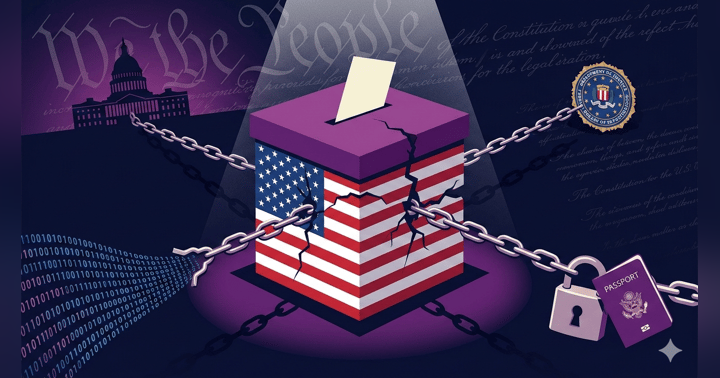
The SAVE Act and the Broader Threat to Election Integrity
The Safeguard American Voter Eligibility Act is being marketed as a common-sense voter ID measure. The reality is more concerning.
The SAVE Act requires proof of citizenship (passport or birth certificate, not just a state ID) to vote. It restricts absentee and mail-in voting. It creates criminal liability for poll workers who make documentation errors. When similar requirements were tested at the state level in Kansas and Arizona, approximately 30,000 voters in each state were disenfranchised.
The problem this legislation claims to solve, non-citizen voting, occurs at a rate of roughly 0.001% according to multiple nonpartisan analyses. It is statistically insignificant.
But the SAVE Act is not an isolated measure. Three other developments paint a much larger picture:
DOGE shared Social Security Administration voter data with outside political advocacy groups that have no government authority to access it. Nine Republican-led states withdrew from ERIC, a bipartisan interstate system that keeps voter rolls accurate and encourages eligible citizens to register. The Trump administration significantly defunded and reduced staffing at the federal agency responsible for protecting election infrastructure from foreign cyberattacks.
Taken together, these actions systematically weaken election security while simultaneously building the narrative and legal framework needed to claim elections are compromised. An executive order under discussion would give the executive branch authority over elections if foreign interference is demonstrated.
Whether this is strategic or coincidental, the pattern warrants serious scrutiny from every American who values democratic governance.
Final Thought
These four stories are not isolated. They are all expressions of the same tension: who holds power, how it's exercised, and whether there are any limits on it. War without congressional authorization. AI without regulation. Information ecosystems without accountability. Elections without equal access.
Paying attention is not optional right now. It's a civic responsibility.
Listen to the full discussion: https://podcasts.apple.com/us/podcast/iran-war-escalates-ai-weapons-race-social-media-ban/id1626987640?i=1000754844532
Purple Political Breakdown: Political Solutions Without Political Bias Alive Podcast Network
Sources:
- Congressional text: SAVE Act (Safeguard American Voter Eligibility Act), H.R. 8281
- Brennan Center for Justice: "Noncitizen Voting Is Extremely Rare" (2024)
- AP News: Strait of Hormuz military operations and oil tanker strikes (March 2026)
- Reuters: Lindsey Graham Fox News statements on Iran escalation (March 2026)
- The Guardian: EU nuclear energy expansion push (March 2026)
- Wired / The Verge: Anthropic government contract refusal and lawsuit (2026)
- NPR: DOGE-SSA voter data controversy (March 2026)
- Ballotpedia: ERIC (Electronic Registration Information Center) state withdrawals
- Department of Justice: Iranian assassination plot sentencing (March 2026)
- CISA: Reporting on staffing reductions and budget cuts (2025-2026)

Podcast Host
Navigating the vast amount of bouncing around the political spectrum my entire life I have finally figured something important out. It doesn't matter. I've been religious, been in the military, went to a liberal school and all in all none of the political biases matter. We shouldn't let toxic discourse cloud our judgement and find a solution through logic and conversation. In pursuit of this mission I created this podcast to focus on these important conversations.

Your Morning Coffee Might Be Funding Modern Slavery. Here's How the Industry Can Change.