Impeachment, War, Inflation, and the Numbers That Define America Right Now
There are weeks in American politics where everything converges at once. This past week was one of them.
As the host of Purple Political Breakdown, a nonpartisan political analysis podcast, I spent this episode walking through five major stories that collectively paint a picture of where the United States stands right now: economically, militarily, constitutionally, and electorally.
Here is what I covered and why it matters.
A Ceasefire That Existed on Paper
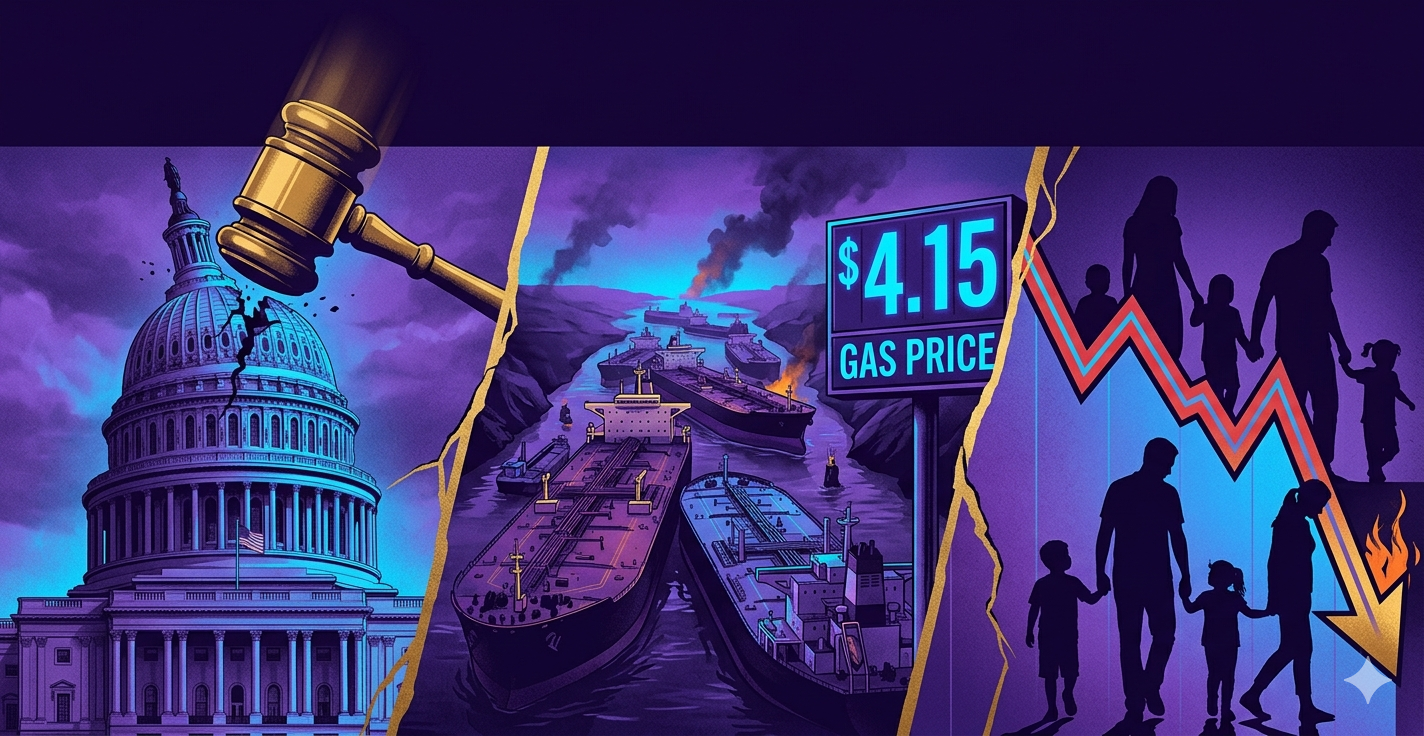
On April 7, the U.S. and Iran agreed to a two-week ceasefire brokered by Pakistan, conditional on Iran reopening the Strait of Hormuz. Both sides declared victory. Then it collapsed. Israel struck central Beirut the next day, killing 254 people and claiming Lebanon was excluded from the agreement. Iran shut the strait again. By April 9, 230 oil tankers were stuck in the Persian Gulf while Iran charged ships over $1 million for passage.
The human toll stands at 13 U.S. service members killed, hundreds wounded, and an estimated 1,665 civilian casualties in Iran, including 248 children. Analysts at the Carnegie Endowment for International Peace called the conflict "a historic strategic defeat" given it was a war of choice. Two-thirds of Americans disapprove of the war.
The strategic question going forward is whether Iran's 10-point peace plan (continued enrichment, sanctions removal, war reparations, U.S. troop withdrawal) can be reconciled with a 15-point U.S. plan that remains classified. Talks are expected in Islamabad, but the trust deficit is enormous.
The Inflation Report No One Wanted
The March CPI report landed with force. Inflation surged to 3.3% annually, driven by a 21.2% single-month spike in gas prices, the largest since 1967. The national average reached $4.15 per gallon, up nearly 40% since the conflict began. For households earning below $30,000, that translates to roughly $223 in additional annual gas costs.
Core inflation (excluding food and energy) remained relatively tame at 2.6%, suggesting the full economic impact of the war has not yet rippled through supply chains. Economists warn that airline fares (up 14.9% annually), shipping surcharges from Amazon, UPS, and FedEx, and broader goods inflation will follow in the coming months.
Real wages declined 0.6% in March, erasing nearly three years of progress. The administration argued that social programs like daycare and Medicaid cannot be funded because "we're fighting wars," a framing that drew criticism from both parties.
A Budget Proposal That Rewrites Priorities
The White House released its fiscal year 2027 budget calling for $1.5 trillion in defense spending, a 42% increase that would represent the largest single-year jump outside a ground war in U.S. history. The proposal includes $65.8 billion for a "Golden Fleet" of Navy ships and $175 billion for the "Golden Dome" missile defense system.
On the domestic side, the budget proposes a 10% cut to non-defense spending ($73 billion), with severe reductions to the EPA (52%), National Science Foundation (55%), and NASA (47%). Programs targeted for elimination include Community Services Block Grants, home heating assistance, and $15.2 billion in renewable energy funding. WIC benefits for breastfeeding mothers would be reduced from $54 to $13 per month.
The budget assumes 3% annual GDP growth for a decade, a target the U.S. has hit only three times in the last 25 years. Independent analysis from the Committee for a Responsible Federal Budget projects debt would rise to 125% of GDP by 2036 under realistic assumptions. Notably, the White House broke with decades of practice by not including 10-year deficit projections.
The Impeachment Question
More than 70 House Democrats and several senators called for Trump's removal after his April 7 Truth Social post threatening that "a whole civilization will die tonight." The calls cited both impeachment and the 25th Amendment as potential mechanisms.
I walked through the full constitutional process on the episode: impeachment requires a simple House majority to bring charges, then a two-thirds Senate supermajority (67 votes) to convict and remove. No president has ever been convicted through this process. Trump has been impeached twice before, both times acquitted by the Senate.
Democratic leadership is proceeding cautiously. House Minority Leader Hakeem Jeffries stated that "we've ruled nothing out and we've ruled nothing in." Several senior Democrats, including former impeachment manager Rep. Madeleine Dean, said impeachment is "not the best use of our time" and that the focus should remain on ending the war, war powers resolutions, and economic messaging ahead of the midterms.
The strategic calculation is clear: a failed impeachment vote risks being perceived as tacit approval, could distract from affordability messaging, and would require Republican votes that do not currently exist. The more likely timeline is post-midterm, if Democrats win the House, which current polling (generic ballot at D+6) suggests is probable.
The Polling Story That Changes Everything
New data shows Trump's net approval with women has fallen to negative 27, a 21-point drop from his 2024 vote share. The most striking finding is that the largest collapse is among white, non-college-educated women, not the liberal, college-educated demographic many would assume. Trump has lost roughly double the support with white moderate and conservative women compared to comparable male groups.
However, this disapproval is not translating into Democratic votes. Despite 65% two-way disapproval among white moderate women, Democrats capture only 49% of their vote. This gap represents both the Republican Party's vulnerability and the Democratic Party's challenge heading into November.
Separately, a new poll found that 61% of Americans still believe hard work will get them ahead in life, despite widespread economic pessimism. The ideological gap on this question has widened to 26 points (49% of liberals versus 75% of conservatives), the largest divergence seen in comparable polling.
Looking Forward
This episode also covered the Epstein investigation (Bill Gates to testify June 10, Howard Lutnick May 6), the Georgia and Wisconsin election results, MAGA infighting, OpenAI's policy blueprint proposing robot taxes and a four-day work week, the U.S. fertility rate hitting a record low, and breakthroughs in gene therapy, cancer detection, and renewable energy.
The full episode is available here: https://podcasts.apple.com/us/podcast/can-trump-actually-be-impeached-iran-ceasefire-collapse/id1626987640?i=1000760931192
Purple Political Breakdown airs weekly. Political solutions without political bias.
Radell Lewis is the host and producer of Purple Political Breakdown on the Alive Podcast Network.
Sources: Associated Press, Reuters, NBC News, CBS News, CNN, CNBC, The Hill, Axios, TIME, Al Jazeera, UN News, PolitiFact, Bureau of Labor Statistics, Center for American Progress, Committee for a Responsible Federal Budget, USA.gov, The Argument/Lakshya Jain (polling), NPR, Washington Post, New York Times, TechCrunch, CDC, Tangle News, University of Cambridge, UCLA Health, Carnegie Endowment for International Peace.

Podcast Host
Navigating the vast amount of bouncing around the political spectrum my entire life I have finally figured something important out. It doesn't matter. I've been religious, been in the military, went to a liberal school and all in all none of the political biases matter. We shouldn't let toxic discourse cloud our judgement and find a solution through logic and conversation. In pursuit of this mission I created this podcast to focus on these important conversations.

Can 8 Democrats Flip Ohio's 7th Congressional District? A Full Breakdown of the Race, the Candidates, and What It Means for 2026