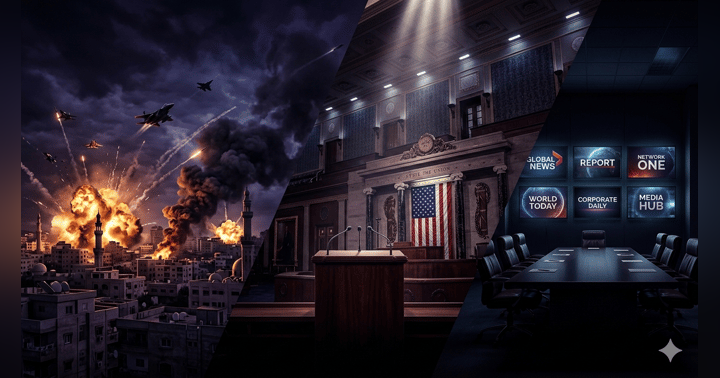
"No New Wars" Was Always a Lie — And the Iran Conflict Proves Why Political Accountability Matters More Than Political Branding
In 2024, "no new wars" was one of the most effective political slogans in American electoral history. It was simple, emotionally resonant, and — as we're now seeing in real time — completely detached from reality.
As the host of Purple Political Breakdown, a nonpartisan political analysis podcast, I spent this week's Socratic Breakdown episode unpacking the U.S.-Iran conflict with my panelists. What emerged wasn't a simple "war good" or "war bad" conversation. It was a case study in why Americans need to stop evaluating leaders by slogans and start evaluating them by strategy.
The Messaging Collapse
Here's what makes this situation uniquely alarming: the Trump administration cannot agree on why this operation was launched. Secretary of State Rubio initially framed it as deterrence and preventing a first strike. Defense Secretary Hegseth described it as targeting nuclear capabilities with no regime change objective. President Trump then contradicted both by claiming he "forced Israel's hand." Rubio subsequently walked back his own comments when confronted by the same reporter the following day.
This isn't partisan criticism — this is a structural governance concern. When the executive branch launches military operations of this scale without Congressional authorization and cannot produce a unified strategic rationale, it signals either profound internal dysfunction or deliberate obfuscation. Neither is acceptable when American service members are in harm's way.
The Data Tells a Different Story Than the Slogan
The "no new wars" framing was always correlational rather than causal. During Trump's first term (2017–2021), the administration ordered approximately 2,243 drone and airstrikes — exceeding the roughly 1,878 ordered across President Obama's entire eight-year tenure. In his current term, U.S. forces have conducted operations across nine countries. The Department of Defense was symbolically renamed the Department of War.
The branding said peace. The data said escalation.
Legitimate Security Interests vs. Strategic Incoherence
This is where intellectual honesty requires nuance. Iran's regime was a genuine threat to regional stability. The Ayatollah presided over the killing of thousands of protesters. Iran funded Hamas, Hezbollah, and the Houthis. Iranian proxies attacked U.S. military bases and planned operations on American soil.
Countries across the Middle East — Israel, Saudi Arabia, and the Gulf States — had legitimate axes to grind. This wasn't manufactured justification in the way Iraq's WMD narrative was.
But legitimate grievances don't automatically produce legitimate strategy. The U.S. has now eliminated the Ayatollah, killed his likely successors, and supported Israeli strikes on the clerical assembly that was set to choose new leadership. There is no governance succession plan. Kurdish forces from Iraq have entered Iran to support ethnic Kurdish populations. Multiple analysts are drawing parallels to the Balkans after Yugoslavia's collapse.
The military operation is executing with precision. The political strategy is nonexistent.
The Economic Ripple Effect
Iran's blockade of the Strait of Hormuz has pushed Brent Crude from approximately $58 to $89-90 per barrel. Oil tankers are queued outside the strait waiting for coalition forces to neutralize Iranian naval defenses. Saudi Arabia has announced plans to increase production to stabilize prices, but the short-term economic disruption is real and global.
For business leaders and investors, the question isn't whether the conflict is justified — it's whether the absence of a strategic endgame creates unpredictable exposure across energy, logistics, and emerging market portfolios.
The Precedent Problem
This is ultimately a governance accountability issue. If military operations of this magnitude can be launched without Congressional authorization, without a unified strategic rationale, and without a post-conflict stabilization plan — and then retroactively justified by pointing at outcomes — we have fundamentally weakened the institutional guardrails that distinguish strategic foreign policy from reactive adventurism.
The Ayatollah being removed may produce short-term security benefits for the region. But the process by which it happened, and the vacuum it creates, will define whether this becomes a strategic achievement or another generational foreign policy failure.
Americans across the political spectrum should be asking the same question: what's the plan for Day 2?
Full breakdown: https://open.spotify.com/episode/7s7BOaDeF7QBpNOifYPWC4
Sources:
- The Guardian — "Rubio tries to backtrack after Israel comments later contradicted by Trump trigger criticism"
- Factually — Comparative drone strike and bombing data: Trump vs. Obama administrations
- Pew Research Center — Russian religious affiliation and practice data
- Brent Crude pricing data — pre-conflict and post-escalation barrel prices
- Ship tracking data — Strait of Hormuz blockade and oil tanker positioning
- The Daily Beast — Historical country bombing comparison across U.S. presidencies

Podcast Host
Navigating the vast amount of bouncing around the political spectrum my entire life I have finally figured something important out. It doesn't matter. I've been religious, been in the military, went to a liberal school and all in all none of the political biases matter. We shouldn't let toxic discourse cloud our judgement and find a solution through logic and conversation. In pursuit of this mission I created this podcast to focus on these important conversations.

We Can Vote for American Idol in Seconds But Can’t Weigh In on a Zoning Decision — Something Is Deeply Wrong