The Business of Protest: What America’s Largest Protest Company Reveals About Civic Engagement, Cred
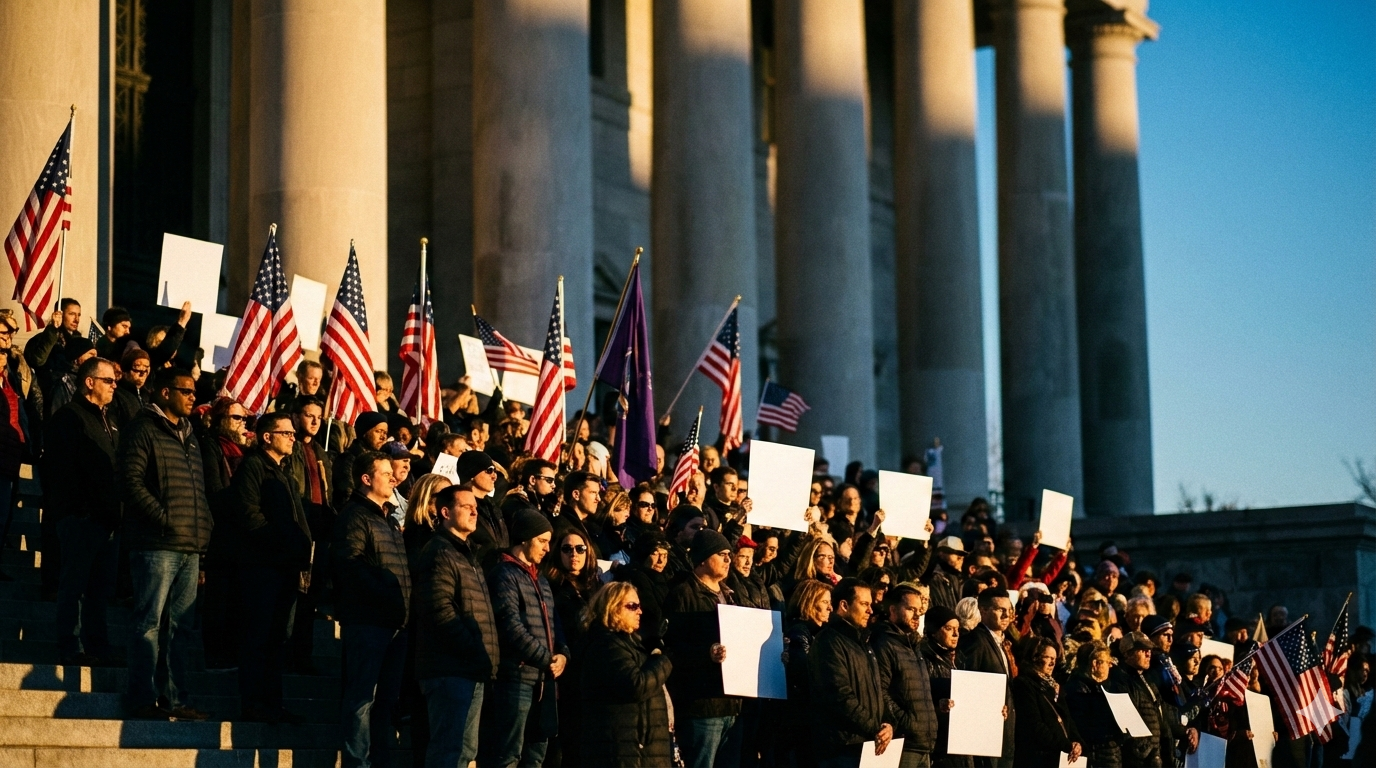
In an era where protests dominate news cycles and civic engagement has become a defining feature of American political life, one question rarely gets asked with any rigor: what actually makes a protest work?
I recently sat down with Adam Swart, the founder and CEO of Crowds on Demand, for an in-depth conversation on my podcast, Purple Political Breakdown. Swart has spent over 13 years running what multiple outlets have described as the country’s largest protest and advocacy firm. His clients span the political spectrum. His company has organized campaigns that secured multibillion-dollar cable carriage agreements, challenged anti-LGBT insurance discrimination, and shaped major corporate mergers.
The conversation challenged assumptions I’ve held for years. It might do the same for you.
The Right to Assemble Is Broader Than Most Americans Realize
One of the most practically useful takeaways from the interview was Swart’s breakdown of protest rights. On public ground, Americans generally do not need a permit to protest. Permits are typically required only for road closures, amplified sound equipment, or large organized events requiring traffic management. The First Amendment protections are robust — but widely misunderstood.
This matters because the perception of needing “permission” to protest creates a chilling effect on civic participation. Many Americans simply don’t exercise their rights because they believe they can’t.
Equally important: speech — even offensive speech — is not a crime under U.S. law. The government cannot punish citizens for expression. However, private employers face no such restriction. Understanding this distinction is essential for anyone considering public advocacy.
Why Tactical Discipline Determines Movement Success
Swart was pointed in his criticism of protest movements that alienate potential supporters. He specifically cited Extinction Rebellion, the UK-founded climate group known for blocking highways and disrupting public transit. His assessment: these tactics generate media attention but actively erode public support.
The data supports this. A 2019 YouGov poll found that 54% of British adults opposed Extinction Rebellion’s disruptive tactics, compared to 36% who supported them. Swart argues that the most effective advocacy campaigns target actual decision-makers rather than inconveniencing the general public.
For organizational leaders and professionals involved in advocacy, this is a critical strategic insight. Visibility without persuasion is noise.
The Credibility Deficit in American Advocacy
The most provocative section of our conversation addressed what Swart calls the credibility crisis in modern movements. His examples spanned the political spectrum:
In the climate space, Taylor Swift’s private jet produced 8,293 tonnes of CO2 in 2022 alone — over 1,100 times the average American’s annual emissions, according to Carbon Market Watch. Meanwhile, a beachfront property connected to former President Obama in Hawaii was found by ProPublica to have exploited coastal planning loopholes in a zone that state projections identify as vulnerable to sea level rise.
On the religious right, the Jerry Falwell Jr. scandal — corroborated by court documents and multiple witnesses — represented a direct contradiction of the family values messaging that had been central to his public platform.
Senator Bernie Sanders’ ownership of three properties (confirmed: Burlington, Vermont; Washington, D.C.; and a Lake Champlain home purchased in 2016 for $575,000) became a recurring talking point that undermined his wealth-inequality messaging for many moderates.
The strategic lesson here isn’t about moral judgment. It’s about organizational credibility. When your most visible advocates don’t live the values your movement espouses, your message becomes vulnerable to dismissal — regardless of its underlying merit.
The Policing Paradox
Swart made a case against the “defund the police” framework that deserves consideration regardless of your political priors. His argument: understaffed police departments create environments where force escalates rather than decreases. When officers feel outnumbered and under-resourced, the conditions for disproportionate response increase.
He cited the Kenosha, Wisconsin situation involving Kyle Rittenhouse, claiming police were absent. Our fact-check revealed this was partially inaccurate — police were present and even provided water to armed civilians before the shootings, but they critically failed to intervene. The problem was not absence but passivity.
This nuance matters for policy. The question isn’t simply more police or fewer police. It’s about what kind of policing, with what accountability structures, produces better outcomes for communities.
Where Public Opinion Is Heading
The current data on public attitudes toward Immigration and Customs Enforcement (ICE) illustrates how rapidly institutional credibility can shift. According to the NPR/PBS News/Marist poll from January 2026, 65% of Americans now say ICE has “gone too far” in enforcing immigration laws, up from 54% in June 2025. The AP-NORC poll from February 2026 found that 60% of Americans view ICE unfavorably. YouGov tracking shows a 30-point net approval drop in a single year.
Former President Obama, in a recent interview on Brian Tyler Cohen’s podcast, described the ICE operations in Minnesota as “deeply concerning and dangerous.”
These numbers should inform any professional working in policy, communications, or organizational strategy. Public sentiment shifts faster than institutional response, and the organizations that fail to read those signals will find themselves on the wrong side of public trust.
Looking Forward
Swart is now advocating for what he calls a “Protesters’ Bill of Rights and Responsibilities” and has proposed to Congress a “Transparency in Political Demonstrations Act” that would require funding disclosure for large demonstrations. Whether you support that specific policy or not, the underlying question — how do we preserve First Amendment protections while building a more transparent civic culture? — is one of the most important conversations in American public life right now.
The full conversation covers these topics and more in depth. I’d encourage anyone interested in civic engagement, advocacy strategy, or the current state of American political culture to give it a listen.
Radell is the host of Purple Political Breakdown on the Alive Podcast Network, a nonpartisan political podcast focused on political solutions without political bias.

Podcast Host
Navigating the vast amount of bouncing around the political spectrum my entire life I have finally figured something important out. It doesn't matter. I've been religious, been in the military, went to a liberal school and all in all none of the political biases matter. We shouldn't let toxic discourse cloud our judgement and find a solution through logic and conversation. In pursuit of this mission I created this podcast to focus on these important conversations.

Democracy in Housing: Why the Black Homeownership Gap Is Wider Than It Was in 1968 and What We Can Do About It