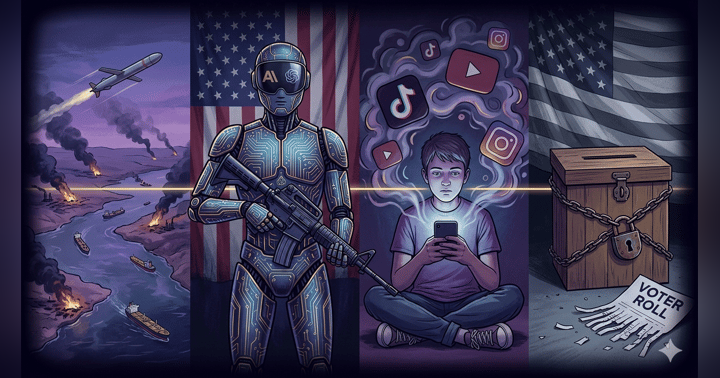
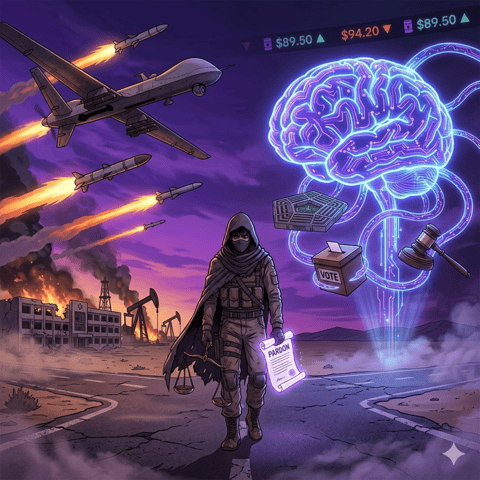
The Iran War, AI's Moral Reckoning, and Why the Pardon System Is Broken: Connecting the Dots on America's Worst Week
There are weeks where the news feels heavy, and then there are weeks where the news feels like it is actively reshaping the country you live in. This was one of those weeks.
On the latest episode of Purple Political Breakdown, I broke down three converging crises that are testing every assumption Americans hold about accountability, technology, and democratic governance. What follows is not a partisan argument. It is an attempt to connect stories that are too often covered in isolation when their intersection is exactly what makes them dangerous.
A War Built on Lies
The U.S. military conflict with Iran has now claimed its seventh American service member. Sergeant Benjamin N. Pennington, 26 years old, died from injuries sustained in an Iranian attack on troops in Saudi Arabia. At least 140 U.S. troops have been wounded. The USS Tripoli, carrying approximately 2,500 Marines, F-35 fighters, and Osprey aircraft, has been deployed from Japan to the Arabian Sea, raising the prospect of a ground offensive in the Strait of Hormuz region.
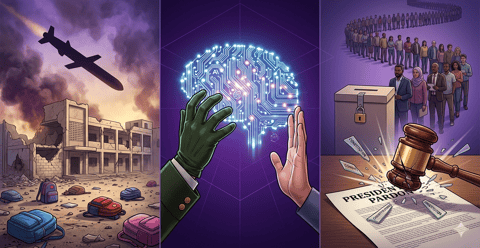
These facts alone represent a significant escalation. But the story that demands the most scrutiny is the strike on the Shahid Tayyebeh girls' elementary school in Minab, Iran.
Newly surfaced video, independently corroborated by Bellingcat, the New York Times, the Associated Press, and CNN, indicates that a U.S. Tomahawk cruise missile was likely responsible for a February 28 strike that reportedly killed 175 people at the school. Investigators matched satellite imagery, shadow analysis, building features, and fragments containing a Department of Defense code. A New York Times review of satellite images from 2013 revealed the school building had previously been part of an Iranian naval base before being partitioned off by 2016. The evidence suggests this was a case of targeting based on outdated intelligence, not collateral damage from a nearby strike.
The administration initially blamed Iran, claiming their inaccurate munitions were responsible. Multiple independent investigations have contradicted that account.
For leaders in any sector, there is a lesson here that transcends politics: institutional credibility depends on transparency, especially when mistakes happen. The instinct to deflect blame may feel protective in the moment, but it accelerates the erosion of the trust that institutions need to function. This applies to governments, corporations, and organizations of every size.
The AI Industry's Defining Choice
While the war unfolded, the artificial intelligence industry faced what may be its most consequential decision to date.
Anthropic declined to allow the Pentagon to deploy its AI models for autonomous weapons systems and mass surveillance without judicial oversight. The Department of Defense labeled Anthropic a "supply risk." Anthropic is now suing over what it describes as retaliatory action.
OpenAI moved quickly to fill the gap, signing a deal with the Pentagon to deploy its models on classified Defense Department networks. Caitlin Kalinowski, OpenAI's head of robotics, resigned on March 7, citing concerns about "surveillance of Americans without judicial oversight and lethal autonomy without human authorization." Her departure triggered a measurable increase in ChatGPT uninstalls. Hundreds of employees at OpenAI and Google had previously signed an open letter calling for limits on AI in surveillance and autonomous weapons.
Google also launched a new AI agent builder for military and civilian applications, and Meta announced its own AI chip and data center infrastructure.
On the governance side, a broad coalition signed the Pro-Human AI Declaration, calling for five principles: keeping humans in control, preventing AI monopolies, protecting the human experience, preserving human agency and liberty, and holding companies accountable. The UN General Assembly approved a 40-member scientific panel on AI impact over U.S. objections. States are introducing legislation to define which jobs AI cannot replace. Ten major foundations launched Humanity AI, a $500 million initiative to fund organizations shaping AI policy.
For professionals in technology, policy, and business leadership, the takeaway is clear: the decisions being made right now about AI's relationship to military power and civil liberties will define the industry's trajectory for decades. Anthropic's choice to say no, and accept the consequences, represents one model. OpenAI's choice to say yes, and absorb the reputational fallout, represents another. The market, the talent pool, and the public will ultimately judge which approach was the right one.
The Pardon Power: A Structural Failure
The third thread running through this episode is one that gets less attention but may have the most lasting implications: the presidential pardon system.
The pardon power originates in Article II, Section 2, Clause 1 of the Constitution. The Supreme Court declared it "unlimited" in Ex parte Garland (1866). It cannot be restricted by Congress or the judiciary. The only constitutional exception is impeachment.
At the Constitutional Convention, Alexander Hamilton argued in Federalist No. 74 that a single executive would dispense mercy more reliably than Congress, which could be swayed by popular passion. George Mason of Virginia warned that presidents could "frequently pardon crimes which were advised by himself," using the power to shield allies and obstruct accountability. James Madison countered that impeachment would serve as the ultimate check.
The historical record shows Mason's concern was well-founded and Madison's safeguard has proven inadequate. From Gerald Ford's pardon of Nixon (which tanked his approval rating and likely cost him the 1976 election) to Bill Clinton's pardon of fugitive financier Marc Rich (which even former President Carter called "disgraceful"), the power has been used in ways the founders did not anticipate and the system cannot correct after the fact.
Representative Steve Cohen (D-TN) has introduced H.J. Res. 13 in the 119th Congress, a constitutional amendment that would prohibit self-pardons, pardons of family members and administration officials, and pardons issued for corrupt purposes. It requires a two-thirds vote in both chambers and ratification by three-quarters of state legislatures. It is the most comprehensive reform proposal currently on the table, and the political bar to pass it is extraordinary.
The Common Thread
These three stories share a single underlying theme: what happens when the mechanisms designed to ensure accountability stop working.
A president can order a military strike based on outdated intelligence, deny responsibility when civilians die, pardon allies who help maintain power, and push legislation that makes it harder for citizens to vote in response. An AI company can arm that same administration with autonomous weapons capability while a competitor gets punished for refusing. And the constitutional safeguards the founders built, from impeachment to the separation of powers, are proving insufficient to the moment.
This is not a partisan observation. It is a structural one. And it is exactly the kind of conversation Purple Political Breakdown was built to have.
Listen to the full episode here: https://podcasts.apple.com/us/podcast/u-s-iran-war-escalation-chatgpts-military-sellout-and/id1626987640?i=1000755394752
Purple Political Breakdown: Political Solutions Without Political Bias.
Sources:
Bellingcat, New York Times, Associated Press, CNN (corroboration of Tomahawk missile strike on Minab school)
New York Times (satellite imagery review, school/naval base partition 2013 to 2016)
Pentagon (140+ wounded U.S. troops, seventh service member death, USS Tripoli deployment)
CBS News (ISIS, Al Qaeda, pro-Iranian group recruitment escalation)
OpenAI resignation statement, Caitlin Kalinowski, March 7
Pro-Human AI Declaration (coalition signatories)
UN General Assembly (40-member AI scientific panel approval)
MIT Election Data and Science Lab (Republican mail-in voting data, 2024)
Department of Justice Office of Legal Counsel (1974 self-pardon memo)
Federalist No. 74, Alexander Hamilton
Constitutional Convention records (Mason, Madison pardon debate)
H.J. Res. 13, 119th Congress (Cohen pardon reform amendment)
Ex parte Garland, 71 U.S. 333 (1866)
FBI (Pennsylvania IED plot, TATP confirmation)
G7 energy ministers (strategic crude reserve discussion)

Podcast Host
Navigating the vast amount of bouncing around the political spectrum my entire life I have finally figured something important out. It doesn't matter. I've been religious, been in the military, went to a liberal school and all in all none of the political biases matter. We shouldn't let toxic discourse cloud our judgement and find a solution through logic and conversation. In pursuit of this mission I created this podcast to focus on these important conversations.

Ohio's 1st Congressional District: The Toss-Up Race That Could Decide the House