We Can Vote for American Idol in Seconds But Can’t Weigh In on a Zoning Decision — Something Is Deeply Wrong
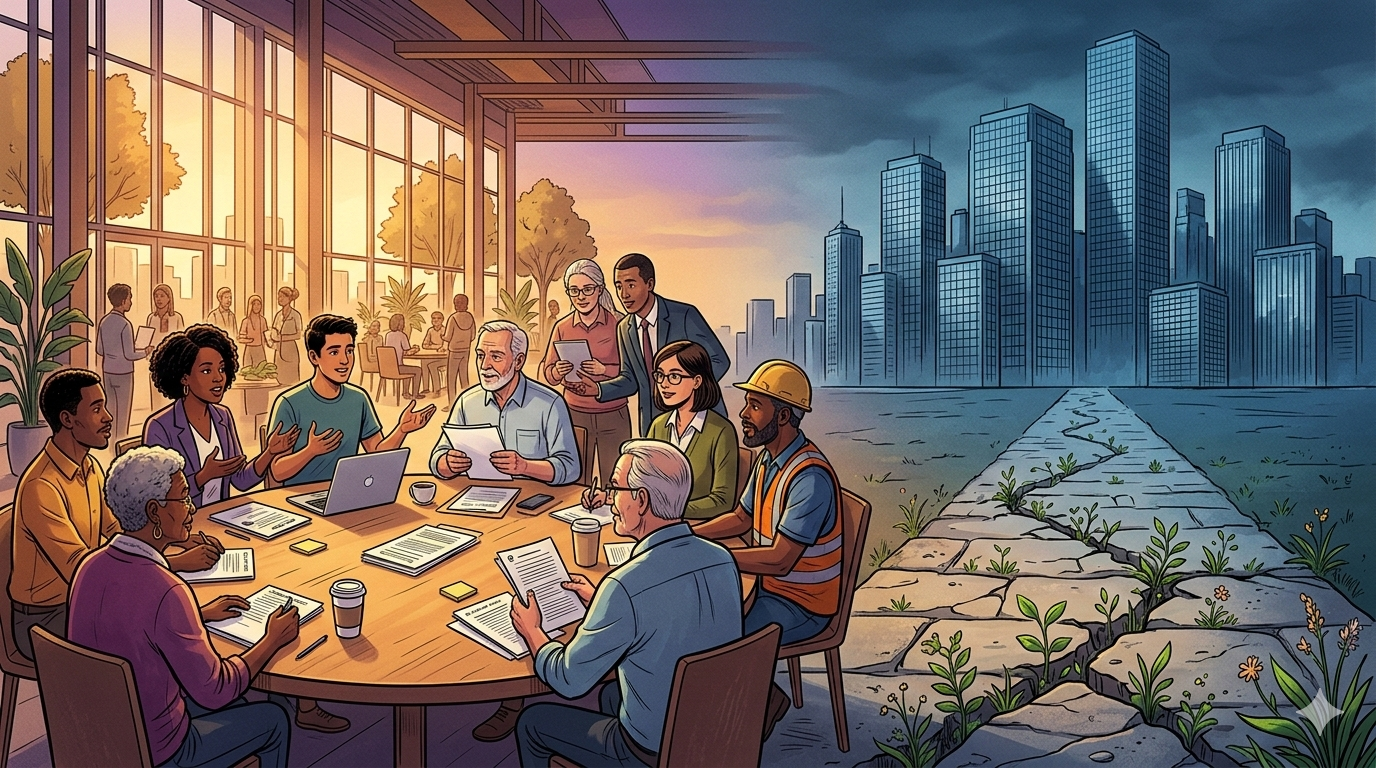
Subtitle: A conversation with Professor Bernd Reiter on deliberative democracy, wealth limits, civic education, and why the richest country in the world can’t figure out how to get its citizens involved
On a recent episode of the Purple Political Breakdown, I sat down with Professor Bernd Reiter, a political science scholar at Texas Tech University who has spent decades studying democratic systems across multiple continents. What was supposed to be a standard interview turned into one of the most thought-provoking conversations I’ve had on the show.
The reason it hit different? Reiter doesn’t just critique what’s broken. He brings actual models from around the world that demonstrate how things could work differently. And some of them are already working.
The Participation Problem Is a Design Problem
Reiter shared an experience that I think most Americans can relate to: he walked into a Texas primary election, looked at the ballot, and didn’t recognize half the candidates. The propositions were unfamiliar. He had to make decisions on the spot without ever having discussed any of these issues with another person.
This isn’t a failure of individual responsibility. This is a design failure. We have built a political system that does not prepare, incentivize, or even make it convenient for citizens to participate meaningfully. When Reiter pointed out that in Germany and most other democracies, election day is a holiday and falls on a weekend, it underscored just how much we accept as “normal” that is actually a choice — a choice that suppresses participation.
What If Lawmaking Worked Like Jury Duty?
The most provocative idea from our conversation was Reiter’s concept of “legal duty” — a system modeled on jury duty where randomly selected citizens are brought together, given information on a policy issue, allowed to deliberate in small groups, and then participate in the actual decision-making process.
This isn’t science fiction. Citizen assemblies have been used in Iceland to draft constitutional amendments, in Ireland to shape referendums on marriage equality and reproductive rights, in Mongolia for constitutional reform, and in Canadian provinces for electoral reform. Professor James Fishkin at Stanford University has pioneered “deliberative polling” that demonstrates ordinary people, when given access to balanced information and structured dialogue, make remarkably thoughtful decisions.
The research on jury duty itself is telling: people who serve on juries subsequently read more news, engage more with politics, and demonstrate greater civic awareness. The experience of being trusted with a real decision changes behavior.
The Education Gap Is the Root Cause
During the conversation, I pushed back on Reiter’s proposals with what I believe is the most foundational issue: education. The system isn’t preparing people to participate in the system. If we implemented robust civic education from a young age — not just memorizing the three branches of government, but field trips to city council meetings, understanding local tax structures, knowing who your state representatives are and what they’re actually doing — we would have a fundamentally different political culture.
Most schools are funded by local property taxes. Most students will live in the same area where they grew up. Why aren’t we connecting the dots between the school, the neighborhood, and the local government that shapes both? This is the most seamless entry point for building a politically literate citizenry because education is something everyone has to do.
The Wealth Conversation We Keep Avoiding
We also got into the wealth inequality conversation, and Reiter introduced a framework I found compelling: predistribution versus redistribution. Instead of only debating how to redistribute wealth after it has concentrated (through taxes), we should be designing systems where people start from more comparable positions.
Consider the data: the average family income of a Harvard student exceeds $400,000. Legacy admissions persist. CEO compensation at S&P 500 companies runs at more than 300 times the average worker’s pay. Japan limits executive compensation. During America’s own Constitutional Convention, a drafted article that would have capped land ownership was discussed but ultimately excluded from the final document.
These conversations are not radical. They are foundational to the American experiment. And we need to be having them with the same energy we bring to debates about minimum wage.
Where I Agree and Where I Diverge
I’m transparent on my show: I’m pro-capitalism, and I believe in the republic model where qualified leaders represent the people. I’m not fully convinced that every person has the capacity or desire to self-govern at the level Reiter envisions. But I am convinced that our current system is not producing leaders who actually represent the people who elect them. I am convinced that education is the foundation for everything else. And I am convinced that if we can vote for American Idol in seconds, we can build feedback mechanisms that let citizens weigh in on local policy decisions.
The status quo is not sustainable. Reiter said something that stuck with me: “We have created a system where the meanest and most cutthroat people end up succeeding.” If that’s what our incentive structures produce, then the structures need to change.
The Bottom Line
We don’t need to tear down the system. We need to improve it — which is exactly what Americans have done throughout history, from Social Security to the Civil Rights Act. The tools exist. The models exist. Other countries are already doing versions of this. What’s missing is political will and public demand.
The full conversation is available now. If any of this resonated, I’d encourage you to listen and form your own conclusions.
Listen here: https://podcasts.apple.com/us/podcast/is-democracy-broken-wealth-inequality-civic-education/id1626987640?i=1000752880750
Podcast Host
Navigating the vast amount of bouncing around the political spectrum my entire life I have finally figured something important out. It doesn't matter. I've been religious, been in the military, went to a liberal school and all in all none of the political biases matter. We shouldn't let toxic discourse cloud our judgement and find a solution through logic and conversation. In pursuit of this mission I created this podcast to focus on these important conversations.

The Week That Should Terrify Every American Who Believes in a Free Press