Your Morning Coffee Might Be Funding Modern Slavery. Here's How the Industry Can Change.
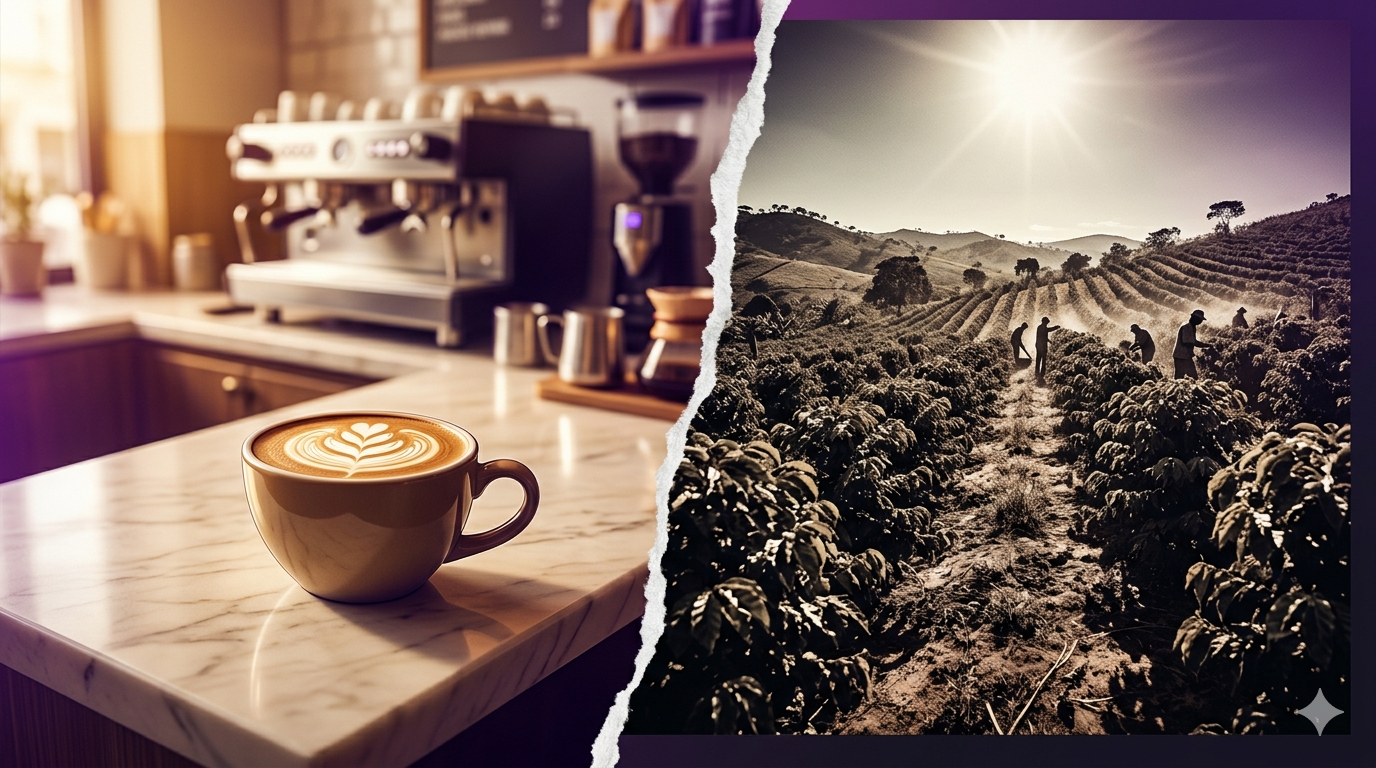
The global coffee industry is worth hundreds of billions of dollars. It fuels productivity, culture, and connection for billions of people every day. But beneath the polished branding and Instagram-worthy latte art, there's a supply chain crisis that most consumers never see.
I recently had a conversation with Etelle Higonnet, founder and director of Coffee Watch, an NGO dedicated to investigating and exposing human rights and environmental abuses in the coffee industry, on the Purple Political Breakdown podcast. What she shared is something every business leader, consumer, and policymaker should understand.
THE NUMBERS THAT SHOULD KEEP US UP AT NIGHT (MORE THAN THE CAFFEINE)
Coffee is consumed at a staggering rate: approximately 2.2 billion cups per day worldwide. Behind that consumption are roughly 12.5 million farms, 25 million farmers, and 100 million farm workers.
Nearly 98% of coffee farmers live in poverty. Half live in extreme poverty, surviving on less than $2.15 per day. Virtually none earn what the development community defines as a "living income," which covers only the bare essentials: food, shelter, and basic medical care.
This poverty is not incidental. It is structural. And it drives a cascade of human rights violations: widespread hazardous child labor, modern slavery and human trafficking, sexual violence against women workers, violent retaliation against unionizing efforts, and massive environmental destruction. Coffee ranks as the 6th largest driver of global deforestation.
WHO IS RESPONSIBLE?
It would be easy to point fingers at coffee-producing countries. But the reality is more uncomfortable. Many of these nations (Ethiopia, Colombia, Mexico, and others) are already struggling with civil conflict, cartel violence, and systemic poverty.
The companies orchestrating these supply chains are headquartered in the United States, Europe, and Switzerland. America is the world's largest coffee consuming nation. Half of all global coffee is traded through Switzerland due to its favorable tax structure.
The exploitation is not happening in spite of Global North demand. It is happening because of it.
THE BUSINESS CASE FOR CHANGE
Here is where it gets interesting for anyone in business or policy. The estimated cost to make a cup of coffee truly sustainable (living income for farmers, elimination of forced labor, no deforestation) is 2 to 3 cents per cup.
That's not a typo. Two to three cents.
For context, recent tariff-driven price increases added roughly $2 per cup to consumer costs. Consumption barely changed. Coffee demand is highly inelastic. The margin needed to transform this industry is negligible compared to what consumers already absorb from market fluctuations.
Coffee Watch, despite being only fifteen months old, has already grown from zero to 3.3 million views across its platforms. They've filed strategic litigation in both the US and Germany against major coffee companies for modern slavery and human trafficking. They've also filed Section 307 petitions with U.S. Customs and Border Protection to block imports connected to forced labor.
THE IMMIGRATION DIMENSION
There's a policy dimension that often goes unmentioned. Millions of coffee farmers across Central America live at or below poverty levels. When climate change and deforestation cause crop failures (and the coffee industry itself drives both through promoting monoculture farming), these communities collapse.
Where do displaced farming families go? They migrate north. The same supply chain exploitation that keeps coffee cheap contributes directly to the migration patterns that dominate American political discourse. If we want to address root causes of immigration, reforming commodity supply chains is a concrete, economically viable starting point.
WHAT CONSUMERS AND LEADERS CAN DO
Individual consumers can research and switch to ethical coffee brands. Options include organic certified coffees, Smithsonian Bird Friendly certified (which combines organic standards with deforestation-free shade-growing), and mission-driven brands like Sofia Vergara's Dios Mio Coffee (focused on women's empowerment in Colombia).
Institutional buyers (universities, corporations, houses of worship, government offices) can audit and change their coffee procurement. Given the volume these institutions consume, a single procurement decision can shift meaningful market share toward ethical producers.
Business leaders can demand supply chain transparency from their vendors. Policymakers can strengthen enforcement mechanisms so that agencies like CBP have the authority and resources to investigate imports proactively, rather than relying on NGOs to present all the evidence.
And everyone can use social media to hold coffee brands accountable. Coffee companies are uniquely brand-sensitive. Consumer pressure works in this industry more than almost any other.
HOPE IS NOT OPTIONAL
As Higonnet put it during our conversation, despair is toxic. It weakens you and means you're walking away from your power. Industries have changed before. The question is not whether the coffee industry can become ethical. It can. The question is whether enough people will demand it.
The cost is pennies. The impact is millions of lives. The tools are already in your hands.
Listen to the full conversation: https://podcasts.apple.com/us/podcast/modern-slavery-child-labor-deforestation-the-coffee/id1626987640?i=1000753866858
---
Sources:
- Purple Political Breakdown Podcast, Episode featuring Etelle Higonnet, Founder and Director of Coffee Watch
- Coffee Watch (coffeewatch.org), investigative reports on modern slavery, child labor, deforestation, and sexual violence in the coffee supply chain
- World Bank definition of extreme poverty ($2.15/day)
- International Labour Organization (ILO) standards on hazardous child labor
- Oxfam reporting on forced labor conditions in Brazilian coffee production
- World Wildlife Fund (WWF) reports on coffee-driven deforestation in Indonesia
- Al Jazeera documentary coverage of slavery rescues in Brazilian coffee farming
- U.S. Customs and Border Protection (CBP) Section 307 forced labor import prohibition
- Coffee Watch litigation filings in U.S. and German courts against major coffee companies

Podcast Host
Navigating the vast amount of bouncing around the political spectrum my entire life I have finally figured something important out. It doesn't matter. I've been religious, been in the military, went to a liberal school and all in all none of the political biases matter. We shouldn't let toxic discourse cloud our judgement and find a solution through logic and conversation. In pursuit of this mission I created this podcast to focus on these important conversations.
Could 21 Million Americans Lose Their Right to Vote? Inside the Multi-Front Battle Over the 2026 Elections


