Neither Team, Not Neutral: The Principles Behind My Politics
For a long time, I could tell you what I thought about almost any political issue. What I couldn't always tell you was why, at least not in a way that held together from one issue to the next.
That bothered me. I host a show called Purple Political Breakdown, and the whole point of it is to break political questions down honestly. It's hard to do that if your own positions are a pile of reactions rather than a system. So I stopped and did the work.
I went back to the foundations. I read through Aristotle's Politics and Plato's Republic and argued with both of them. I studied the far left, the far right, the libertarian and anarchist traditions, and the centrist and moderate schools, not to pick one, but to see what each gets right and where each breaks. I worked through the history of our own party system, from the collapse of the Whigs to today's record number of independents. And I took thirty of the hardest paired questions in political philosophy, equality versus fairness, liberty versus security, nation versus world, and forced myself to answer each one in a way that stayed consistent with all the others.
What came out the other side is a framework. I'm sharing it because I think anyone who asks for your attention on politics owes you a clear account of where they stand. This is mine.
If I had to put a label on it, I'd use the one a political identity assessment gave me: progressive realist. Progressive about where we should end up. Realistic about how we get there, and honest that no government can guarantee anyone's life turns out well.
One question underneath everything
Every position I hold comes back to a single question: does this help a person become the best version of themselves?
That's what I think politics is for. Not winning, not punishing the other side, but optimizing the conditions for human flourishing, for individuals, for families, and for a society that keeps going and keeps getting better.
Three rights, not thirty
When I started, I assumed I'd end up with a long list of human rights. I tried to defend food, water, shelter, healthcare and education each as a standalone right, and I couldn't do it consistently. Every version either collapsed under its own logic or required someone specific to owe someone else a specific thing.
So I came back to the three rights this country was founded on, and found they hold up better than anything I could invent.
Life. The right to exist and be protected from having that existence ended or endangered. The hardest question here is when it begins. I landed on sentience, around 24 weeks, when the connections that allow the brain to perceive and feel first form. I chose that line because it rests on science rather than faith, and because sentience is the moment there is someone with a stake in their own future.
Liberty. Freedom from arbitrary interference, by the government or anyone else, in how you think, speak, worship, move and associate. This is the cleanest right to defend, and I protect it almost without exception.
The pursuit of happiness. This one gets misread constantly. It isn't a promise that you'll be happy. It's a promise that no unjust barrier, especially one tied to something you can't change like your race or sex, will block your path to growing into whatever flourishing means for you.
Here's where I'll lose some people on both sides: I don't believe healthcare is a human right. I don't believe food or housing are either. They are something just as important and more precise. They're the systems that make the three real rights possible. You can't pursue happiness while starving, and liberty means little without an education to exercise it. So the government has a real obligation to keep those systems reliably within reach for everyone. That's a stronger commitment than calling them rights, not a weaker one, because it puts the focus on whether the system actually works.
A floor, then a fair shot
One of the oldest fights in politics is equality versus fairness. My answer is that you need both, in different places.
Below a certain line, everyone gets the same thing: their basic rights, fully protected. That's the floor, and it isn't negotiable. Above the floor, the goal changes. It's no longer equal outcomes. It's a fair shot.
I'm fine with people becoming extraordinarily successful. What I'm not fine with is success at the top that comes with a locked door at the bottom. So my test for whether inequality is acceptable is simple: is there a real, visible, reachable pathway for people at the bottom to benefit from what's happening at the top? Jobs, public investment, a path up. I don't need to measure whether everyone's outcome improved. I need to confirm that the door exists and actually opens.
The same thinking changed how I see merit. Test scores and credentials are a thin measure of who should lead or be hired. What actually matters is fit: whether someone can work with others, build relationships, and serve people who aren't like them. We need to broaden what we select for and, at the same time, improve the conditions people grow up in so more of them can meet that standard.
Purposeful government
I've never found "big government versus small government" useful. It argues about size when the real question is purpose.
So I use a different term: purposeful government. It should be fully present and strong wherever it's needed to protect the floor, and deliberately restrained everywhere else. How big it ends up is a result of doing its job, not a goal in itself.
In practice, that means asking two questions of every rule: does it stop a real, identifiable harm, or does it just add burden with no clear victim? And who benefits from keeping it in place? A lot of what holds this country back, like the permitting and zoning rules that make it nearly impossible to build enough housing, fails that test.
It also means the government's role is to build people up, then step back. Give people education, access and opportunity, then let them make their own choices, including choices I wouldn't make. People have to be allowed to fail or flourish on their own terms. A government that tries to engineer the outcome of your life isn't helping you. It's managing you.
Nobody is above the law
If there's one principle I'd put on a billboard, it's this one. Politicians, billionaires, officers, officials, anyone with power: the same rules, the same accountability.
That doesn't make me anti-success. I think populism gets something important right when it says a small group has captured too much power. But it gets something important wrong when it lumps every successful person into one enemy. People who built something real through genuine effort deserve respect. People who used their position to get above the rules deserve consequences. A movement that can't tell those two apart is swinging a blunt instrument.
It also means I hold the institutions I respect to account. I respect the military and law enforcement as roles, and I served in the Marine Corps myself. But respect for the role doesn't excuse misconduct by the person in it. The uniform earns respect in principle. The conduct has to earn it in practice.
Trust is the real crisis
For generations, American government ran on implied authority. People broadly trusted that the system worked, even if they didn't follow it closely. Social media and a flood of misinformation broke that. Trust is no longer assumed; it has to be earned in public, over and over.
I think that's fixable, and I think the same tools that broke trust can rebuild it. Some ideas I've landed on: much stronger civics education with real participation built in; nonpartisan local news, publicly supported, that translates what government does into something people can actually follow; tougher vetting for appointed officials, including public hearings with questions from citizens; and full transparency about where tax dollars go. People are willing to pay into a system they can see working. They lose faith when they see public money funding stadiums instead of services.
Democracy at the right scale
I support representative democracy nationally and more direct democracy locally. At the national level, no citizen can track everything, so we elect people to use real judgment on our behalf, not just follow the loudest voices. At the local level, where the effects are close and people can see results, citizens should have a more direct say, and technology makes that more possible than ever.
And I'm grateful for the constitutional limits on majority rule. They're what stops a 51 percent majority from voting away anyone's basic rights. That's the floor, protected in the structure itself.
Patriotism without nationalism
I'm proud of this country. But I draw a hard line between patriotism and nationalism. Patriotism is love of country that stays honest about its flaws. Nationalism, in the sense of unconditional loyalty that treats criticism as betrayal, isn't something I'll sign on to.
And ethnic nationalism is simply wrong. What makes someone American is a set of shared ideals, not blood or background. Anyone can become American by embracing those ideals, and I'm glad when people do. The term for this is civic nationalism, and it's the only kind I believe in.
On the world stage, my heart is broad but my priorities are practical. We have finite resources and finite capacity for empathy, so our first obligations are to our own people. We lead abroad by example, not by isolation and not by conquest. We should speak up for human rights everywhere, and act, together with allies, when there's clear proof of the worst abuses: slavery, torture and genocide. I believe in peace through strength, and in a sovereignty that a government earns by actually serving its people.
The traditions worth keeping
I spent real time with the conservative tradition, and I came away respecting more of it than I expected. My approach is to separate what a tradition does from the institution around it, and keep whatever still serves people.
What I keep: self-reliance, meaning taking responsibility for your own growth, with a society that makes that growth possible. The family as an anchor. Voluntary, local community. Respect for the people who serve. And love of country. The one thing I translate rather than keep whole is organized faith: I value what religious community does for moral formation and belonging, and I think those same goods can be built without requiring a particular religion.
I also think we've lost the ability to talk about men and women honestly. Two things are simply true: women can bear children, and men are on average physically stronger. Neither fact dictates anyone's role. Every person is free to live however they choose, with the same rights and the same opportunities. But we can still celebrate the mother who raises her family and the man who shows up to protect and provide, without mandating it and without looking down on anyone who chooses differently.
This matters because a lot of young men right now are searching for purpose and finding it in corners of the internet that sell them contempt. I'd rather offer them the real thing: courage and perseverance aren't just virtues to be proud of, they're the tools you use to build the family and community you want. And for women, I want to honor the kind of strength that doesn't just endure hard things but changes them, the care that starts at home and radiates outward into fighting for everyone who's been left out.
On identity more broadly: representing people matters, but no identity should be the whole platform. And calling people racist as a first move almost never changes a mind, even when it's accurate. We have to be more deliberate than that.
Principles over popularity
The last idea may be the one I care about most. A decision made on sound principle isn't unjust just because people are unhappy with the result. And a decision made through manipulation isn't justified just because people like how it turned out. How people feel about an outcome matters, but it's a different question from whether the decision was right.
I hold myself to that too. My personal compass comes down to a handful of principles: forgiveness, genuine care for other people's well-being, empathy, a willingness to grow my own perspective, and truth joined with justice, because truth without justice can be cruel and justice without truth is just power. I don't expect anyone to adopt my framework whole. I do think everyone who leads should be able to explain theirs.
I also try to stay realistic. The ideal society is something we move toward, never something we fully reach. That's not a reason to give up on it. It's a reason to take every real step of progress seriously instead of waiting for perfection.
What this means for Purple Political Breakdown
This is the lens I'll bring to every episode, every guest and every policy we break down. When a proposal comes across the show, I'll ask whether it protects life, liberty and the pursuit of happiness; whether it builds people up or tries to manage them; whether it stops a real harm; whether it holds everyone accountable, including the powerful; and whether it can survive full honesty and transparency.
If it passes, I'll say so, no matter which party it came from. If it doesn't, I'll say that too, and explain why.
That's what I mean by nonpartisan but not neutral. I'm not asking you to agree with me. I'm asking you to hold me to this, and to think about what your own framework would look like if you wrote it down.
Radell Lewis is the host and producer of Purple Political Breakdown on the Alive Podcast Network, and a U.S. Marine Corps veteran.
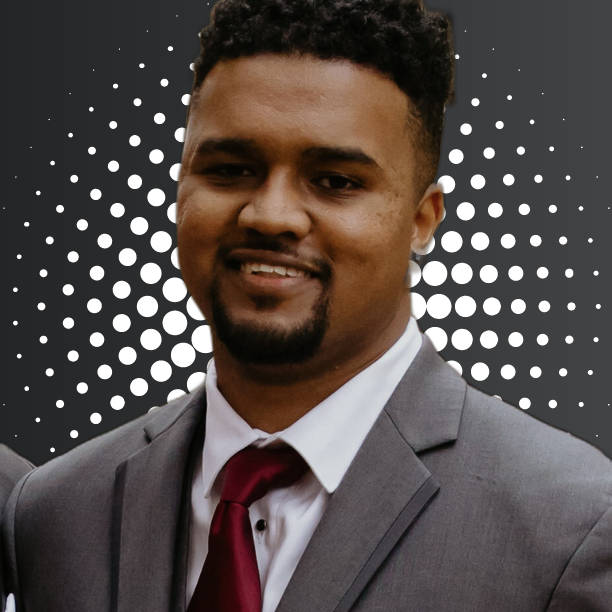
Podcast Host
Navigating the vast amount of bouncing around the political spectrum my entire life I have finally figured something important out. It doesn't matter. I've been religious, been in the military, went to a liberal school and all in all none of the political biases matter. We shouldn't let toxic discourse cloud our judgement and find a solution through logic and conversation. In pursuit of this mission I created this podcast to focus on these important conversations.


